Today's game stop

Shade
Shade is a daily guessing game where you slide a value to shade one missing piece of a chart so its color matches data-driven coloring; three new charts appear each day at midnight.
Play ShadeA fresh puzzle is waiting for you.
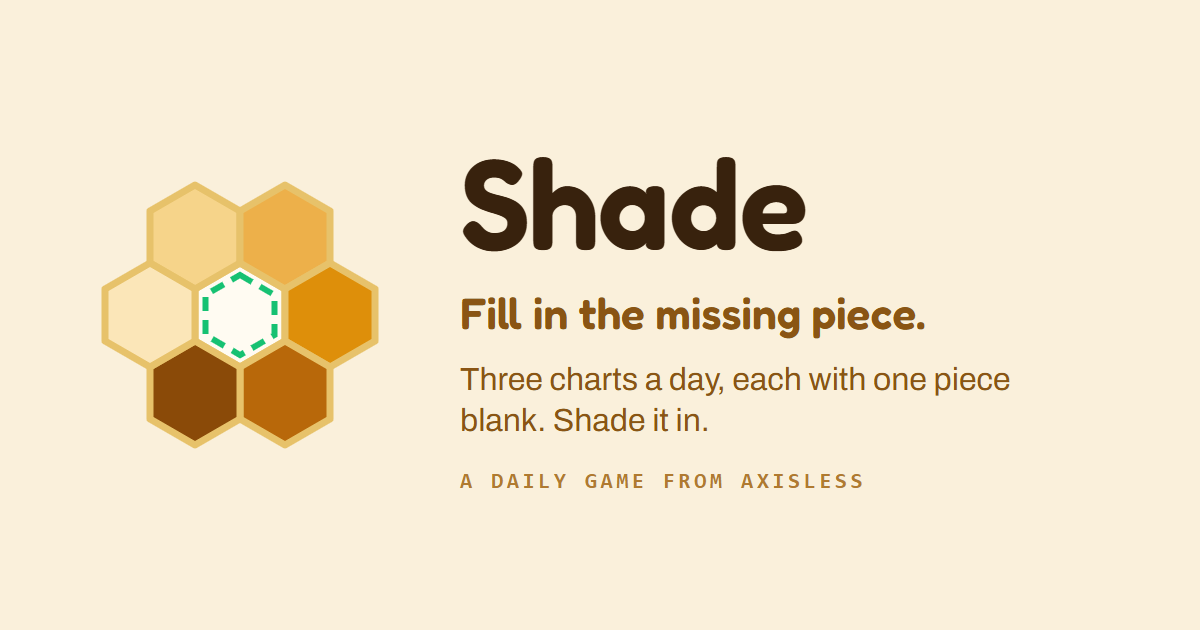
Shade presents three data-colored charts daily and asks you to infer the missing numeric value by eye. Each chart maps a real number to a color scale so darker tones mean larger values. You drag a slider to set the blank piece's shade, submit your guess, and see the true value and the data source that produced the map.
Shade scores each guess on a 0, 100 scale based on how close your chosen value is to the real number. Charts vary by theme and layout: examples include world maps, a keyboard, a Monopoly board and a skeleton. The site provides extra practice puzzles and a review mode labeled beta, and it credits Paul Longe as the creator.
How to play Shade
- How to play Shade: open a chart and read the color ramp and legend to see how higher numbers map to darker colors.
- Drag the slider to change the color of the blank piece until its color looks right compared with surrounding pieces.
- Place your guess by submitting the slider value to reveal the true number and the explanation of the underlying data.
- Repeat for the three daily puzzles, and use the practice or extra puzzles if you want more plays beyond the daily set.
Tips for Shade
- Compare the blank piece to the closest neighbors first to narrow the approximate value range before adjusting the slider.
- Check the color ramp or legend carefully to know whether darker means larger values or the reverse; Shade uses darker to indicate larger values.
- Use the practice and extra puzzles to calibrate how fine-grained the slider feels for different datasets before playing the daily set.
- If the chart is global or categorical, look for outliers or known extremes to anchor your estimate and reduce large errors.
Shade FAQ
What is Shade?
Shade is a daily puzzle where you guess a missing real number by adjusting a slider so a blank piece matches the color produced from open data; each chart is colored by a real numeric value and darker colors represent larger values. You then submit your guess to see the true value, an explanation and the data source used to generate the chart.
Is Shade free to play?
Yes, Shade is available to play on the site without a price shown on the page. The interface offers three daily puzzles plus options labeled practice, five extra puzzles and an unlimited beta mode for additional play.
How many puzzles does Shade give each day?
Shade provides three new charts every day. The page also offers practice rounds, a five-extra-puzzle option and an unlimited beta mode for more attempts beyond the daily three.
When do new Shade puzzles appear?
New Shade puzzles are released every midnight. The site explicitly states that new puzzles arrive at midnight, so the daily three refresh at that time.
How is my Shade score computed?
Shade scores guesses on a scale from 0 to 100 based on how close your slider value is to the true numeric value. The closer your submitted value is to the real number the chart was colored from, the higher your score out of 100.
What do the colors in Shade mean?
In Shade, darker colors indicate larger numeric values. Each chart is colored by a real number and the color ramp maps lower to higher values, with darker shades corresponding to higher quantities.
Can I play extra or past Shade puzzles?
Yes, the site provides practice rounds and a five extra puzzles option, and it also shows a review puzzles beta feature. Those features let you play beyond the three daily puzzles and revisit puzzles in the review mode.
Who made Shade?
Shade was made by Paul Longe. The site credits Paul Longe on the game page as the creator.